Why Most Beginners Quit Within Two Weeks (And How to Avoid It)
When I first tried to start exercising at home, I made every mistake you can imagine. I jumped into a 30-minute YouTube HIIT routine, ignored the pain in my knees, and felt so sore the next day I couldn't walk downstairs. I quit after three sessions. That was eight years ago, before I learned what actually works for beginners.
The problem isn't that you lack willpower. It's that most beginner-friendly workouts with no equipment are designed by people who forgot what it feels like to be a beginner. They throw 10+ exercises at you, tell you to do 30 seconds of work with 10 seconds rest, and assume you know what a neutral spine looks like. You don't, and that's okay.
What I wish someone had told me: the safest, most effective way to start is the 3-3-3 Rule. Three minutes of mobility prep, three exercises done with perfect form, and three minutes of cooldown and body listening. No equipment. No confusion. No injury.
This article is that guide. By the end, you'll know exactly how to start exercising for beginners without equipment, why 10 minutes is actually enough, and how to build a habit that sticks.
What Is the 3-3-3 Rule for Working Out?
The 3-3-3 rule is a framework I developed after years of coaching total beginners - and failing with them until I stripped everything down. It's not a viral gimmick; it's a practical answer to the question: "What is the minimum effective dose of movement that is safe, scalable, and repeatable?"
Here's the breakdown:
- 3 minutes of mobility prep - dynamic stretches that wake up your joints and prevent injury. Most people skip this and wonder why their shoulders hurt during push-ups.
- 3 exercises - not 8, not 12. Three compound movements that work your whole body. You do them slowly, focusing on form over reps. The goal is to feel the right muscles working, not to finish in a sweat.
- 3 minutes of cooldown - static stretching and a mental check-in. This is where you ask yourself: "How did that feel? What could I adjust next time?" This addresses the anxiety of "Is this enough?" because you learn to trust your body's signals.
Most people don't realize that the real barrier to consistency isn't physical - it's psychological. The 3-3-3 rule removes the overwhelm of complex routines and gives you a simple, repeatable structure. You can do it in 10 minutes, or you can extend it by adding more rounds. But start with one round.
How to Start Exercising for Beginners Without Equipment: The 3-3-3 Protocol
You don't need a mat, weights, or even athletic shoes. Bare feet on a carpet or rug work fine. I've done this routine in a hotel room, in my living room, and even on a park bench. Here's the exact protocol.
Phase 1: 3 Minutes of Mobility Prep
Set a timer for three minutes. Do each movement for 30 seconds, flowing smoothly without rushing. This isn't stretching to the point of discomfort - it's waking up your joints.
- Neck tilts and rolls (30 seconds) - Slowly drop your right ear toward your right shoulder, then left. Then roll your chin to your chest and back up. Most people hold tension in their neck during push-ups. This prevents that.
- Arm circles (30 seconds) - Small circles forward, then backward. Gradually increase the diameter. This warms up the shoulder joint, which is the most vulnerable for beginners.
- Cat-cow on the floor (30 seconds) - On hands and knees, alternate between arching your back (cow) and rounding it (cat). Move with your breath. This mobilizes the spine before any squat or lunge.
- Hip circles (30 seconds) - Standing, hands on hips, make slow circles. This is crucial because tight hips lead to bad squat form.
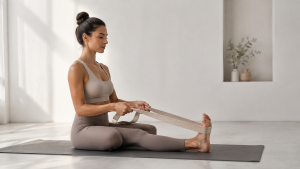
- Ankle circles and toe taps (30 seconds) - Sit down, extend one leg, and rotate the ankle. Then stand and tap your toes. Ankle mobility is the most overlooked joint for beginners.
- Deep breathing with arm raise (30 seconds) - Inhale as you raise both arms overhead, exhale as you lower. This syncs your breath with movement, a skill you'll use in every exercise.
If you feel any sharp pain during this phase, stop. That's your body saying something is wrong. The thing nobody tells you about mobility prep is that it's also a diagnostic tool - you learn where you're tight or weak before you load the movement.
Phase 2: 3 Exercises (Form Over Reps)
Now you choose three exercises from the list below. I recommend starting with the first three: glute bridge, wall push-up, and bodyweight squat. These are the safest for a true beginner. As you get stronger, swap in lunges, plank variations, or floor push-ups.
Exercise 1: Glute Bridge (works glutes, hamstrings, lower back)
- Lie on your back, knees bent, feet flat on the floor hip-width apart.
- Press your heels into the floor and lift your hips toward the ceiling. Squeeze your glutes at the top.
- Lower slowly. Do 8-12 reps. If you can't feel your glutes working, place your hands on your glutes to feel the contraction.
Exercise 2: Wall Push-Up (works chest, shoulders, triceps)
- Stand facing a wall, arms extended, palms flat on the wall at shoulder height.
- Bend your elbows and lean your chest toward the wall. Keep your body in a straight line from head to heels.
- Push back to start. Do 8-12 reps. This is much easier than floor push-ups and lets you practice proper form. For a deeper dive on progressing to floor push-ups, see our guide on How to Do Proper Beginner Push-Ups.
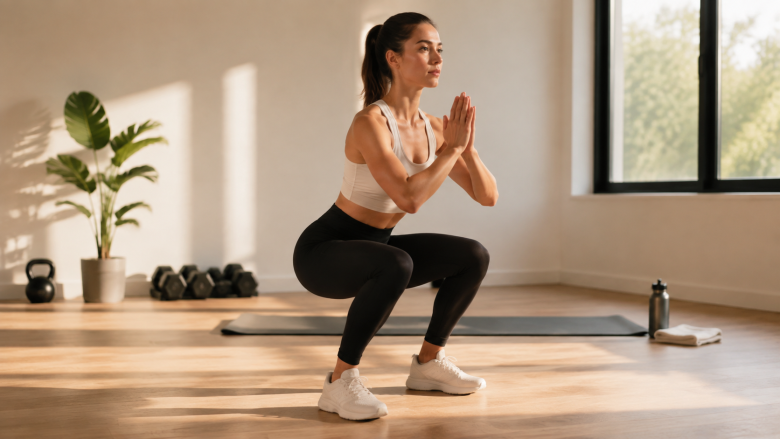
Exercise 3: Bodyweight Squat (to a chair) (works quads, glutes, core)
- Place a sturdy chair behind you. Stand with feet shoulder-width apart.
- Lower your hips back and down as if sitting in the chair. Tap the seat lightly, then stand back up.
- Keep your chest up and weight in your heels. Do 8-12 reps. If your knees cave in, widen your stance.
Do one set of each exercise, resting 30-60 seconds between exercises. That's one round. Repeat the round 2-3 times if you have time and energy, but never sacrifice form for more reps. If you feel your back arching or your knees wobbling, stop and reset.
Most people don't realize that three exercises done correctly are more effective than ten exercises done poorly. Your nervous system can only learn one movement pattern at a time. By focusing on three, you build a solid foundation.
Phase 3: 3 Minutes of Cooldown + Body Listening
Set a timer for three minutes. This is not optional. It's where you prevent next-day soreness and build the habit of listening to your body.
- Child's pose (60 seconds) - Kneel, sit back on your heels, and extend your arms forward on the floor. Breathe deeply. This releases the lower back.
- Standing forward fold (60 seconds) - Stand, bend forward at the hips, and let your arms hang. Keep a slight bend in your knees. Feel the stretch in your hamstrings.
- Body scan (60 seconds) - Lie on your back with your hands on your belly. Close your eyes. Ask yourself: "Where did I feel the most effort? Any discomfort? How do I feel emotionally?" This is the part that addresses the "Is this enough?" anxiety. You'll realize that any movement is better than none, and that you don't need to be exhausted to benefit.
If you're short on time, you can do the three minutes of cooldown as a standalone practice. That's still a win. For more on finding time for movement in a busy schedule, check out How to Find Time for Beginner Movement.
Is a 10 Minute Workout a Day Enough?
Yes, for a beginner, 10 minutes is enough to build strength, improve mobility, and create a habit. The research backs this up. A 2019 study in the British Journal of Sports Medicine found that as little as 10 minutes of moderate-to-vigorous physical activity per day was associated with a 20% reduction in cardiovascular disease risk. But more importantly, for someone who hasn't exercised in months or years, the biggest predictor of long-term success is consistency, not intensity.
If you try to do 30 minutes from day one, you'll likely overtrain and quit. A 10-minute session that you actually do is infinitely better than a 30-minute session you dread. The 3-3-3 rule fits perfectly into a 10-minute window. As you get stronger, you can add a second round, bringing it to 15-20 minutes, or combine it with a short walk. But never feel guilty for doing only 10 minutes.
What burns 500 calories in 30 minutes? For a beginner weighing 150 pounds, a 30-minute vigorous run would burn about 300 calories, not 500. That's a common misconception. The 500-calorie figure often comes from high-intensity interval training or very heavy lifting, which is not safe for beginners. The 3-3-3 rule might burn 60-80 calories in 10 minutes. That's fine. Your goal is not to burn a specific number; it's to build a sustainable practice. Over time, as you add more rounds, your calorie burn naturally increases.
The Psychology of Sticking With It (What Nobody Tells You)
When I finally started exercising consistently, it wasn't because I found the perfect routine. It was because I stopped trying to be perfect. I let go of the idea that I had to feel the burn, that I had to sweat, that I had to do it every single day. The 3-3-3 rule works because it removes the all-or-nothing mindset.
Here are three psychological barriers that the 3-3-3 rule addresses directly:
- Barrier 1: The "I don't know what to do" confusion. With only three exercises, the decision fatigue disappears. You can memorize them in one session.
- Barrier 2: The "I didn't work hard enough" guilt. The cooldown body scan teaches you to value effort over output. You learn that feeling good after a workout is a better metric than feeling exhausted.
- Barrier 3: The "I'll start when I'm stronger" procrastination. The 3-3-3 rule is so accessible that you have no excuse not to do it. It's literally 10 minutes. You can do it in your pajamas.
I've seen beginners who started with the 3-3-3 rule progress to doing full push-ups, pull-ups (with a bar), and even running 5Ks within a few months. The key was that they never skipped a session because they never felt like it was too hard. They built momentum.
Common Mistakes Beginners Make (And How to Avoid Them)
Even with a simple protocol, things can go wrong. Here are the most common mistakes I've seen, and how to fix them.
Mistake 1: Holding your breath during exercises. Many people unconsciously hold their breath when they exert. This increases blood pressure and reduces oxygen to muscles. Fix: exhale during the effort (lifting up, pushing away), inhale during the lowering phase. Practice this during the mobility prep for 30 seconds.
Mistake 2: Rushing through the reps. Beginners often speed up to finish faster, but that's when form breaks. Fix: count to three on the way up, and three on the way down. Use a metronome or a slow internal count. If you can't feel the target muscle working, slow down.
Mistake 3: Ignoring pain vs. discomfort. Muscle burn is normal. Sharp pain in joints is not. If you feel a sharp pain in your knee during a squat, stop. Try a narrower stance or a shallower range of motion. The thing nobody tells you about bodyweight exercise is that you can always regress a movement. The wall push-up is a regression of the floor push-up. The chair squat is a regression of a full squat. Use regressions, don't push through pain.
Mistake 4: Doing the same three exercises every day. Your body adapts quickly. After two weeks, switch one of the exercises. For example, replace the glute bridge with a single-leg glute bridge (for balance) or replace the wall push-up with an incline push-up on a sturdy table. This prevents boredom and plateaus.
When to Progress: Scaling the 3-3-3 Workout
The 3-3-3 rule is designed to be scalable. You don't need to abandon it after a month. Here's how to progress safely.
- Week 1-2: One round of the three exercises (8-12 reps each). Total time: ~10 minutes.
- Week 3-4: Two rounds. Rest 60 seconds between rounds. Total time: ~15 minutes.
- Week 5-6: Three rounds. Increase reps to 12-15. Add a new exercise (e.g., lunges or plank). Total time: ~20 minutes.
- Week 7-8: Three rounds with a harder variation of each exercise. For example: floor push-ups (knees or full), squats without the chair, and glute bridge with a leg lift. Total time: ~20 minutes.
If at any point you feel joint pain, unexplained fatigue, or loss of motivation, drop back to the previous level. This is not failure; it's smart training. The 3-3-3 rule is a lifelong framework, not a two-week program.
How to Combine the 3-3-3 Rule With Other Daily Movement
This workout is not a complete solution for overall health - it's a starting point. But it pairs well with other gentle activities. For example, you can do the 3-3-3 routine in the morning, then take a 10-minute walk after lunch. Or you can do it as a warm-up before a longer walk. For a broader perspective on incorporating movement into your day, see the Beginner's Guide to Everyday Wellness Steps.
If you're curious about other low-impact options, the Beginner's Guide to Light Exercise Basics covers walking, stretching, and balance exercises that complement the 3-3-3 rule. And for the mental aspect of staying consistent, the Beginner's Guide to Mindful Daily Movement offers tips on building a mindful routine.
Frequently Asked Questions (Answered Naturally)
You might still be wondering about some specifics. Let me address them here, woven into the flow.
"What is the 3 3 3 rule for working out?" I've already explained it in detail, but let me add one nuance: the 3-3-3 rule is not a rigid prescription. Some days you might only do 2 minutes of mobility and 2 minutes of cooldown. That's fine. The spirit of the rule is to ensure you never skip the warm-up and cool-down, and that you never overload yourself with too many exercises. If you forget the exact numbers, just remember: start gently, do a few moves well, and finish with a check-in.
"Is a 10 minute workout a day enough?" For building a habit and maintaining basic mobility, absolutely. For significant weight loss or muscle gain, you'll need to increase volume over time. But the 10-minute habit is the foundation. Once you're consistent for 30 days, you'll naturally want to do more.
"What burns 500 calories in 30 minutes?" For a beginner, that's unrealistic. A 30-minute moderate-intensity workout (like brisk walking at 3.5 mph) burns about 120-150 calories for a 150-pound person. High-intensity running or cycling could burn 300-400, but that's not for beginners. The 3-3-3 rule is not about calorie burn; it's about building a sustainable practice. If you want to increase calorie burn, add a daily walk.
"How to start exercising for beginners without equipment?" You already have the answer: the 3-3-3 protocol. Start today. Don't wait for a new year or a Monday. Do it right now. Stand up, shake your arms, and do the mobility prep for 3 minutes. That counts as a win.
Your First Session: A Step-by-Step Walkthrough
Let me walk you through your very first session so there's zero guesswork.
- Find a quiet space where you won't be interrupted. Put your phone on silent.
- Set a timer for 3 minutes for mobility prep. Do the six movements listed above. If you only have time for three, that's okay.
- Choose your three exercises. For your first session, use glute bridge, wall push-up, and squat to a chair. Do 8 reps of each, taking your time. Rest 30 seconds between exercises.
- After the first round, ask yourself: "How do I feel?" If you feel good, do a second round. If you feel tired, stop. There's no shame in stopping after one round.
- Set a timer for 3 minutes for cooldown. Do child's pose, forward fold, and the body scan. During the body scan, notice any tightness or tightness. Make a mental note to be gentler next time.
- That's it. You're done. You have just completed a beginner-friendly workout with no equipment.
Afterward, drink a glass of water. You don't need a protein shake or a recovery supplement. Just move on with your day.
What to Do If You Miss a Day (Or a Week)
Life happens. You might skip a day because you're sick, busy, or just not feeling it. The 3-3-3 rule is designed to be forgiving. If you miss one day, don't double up the next day. Just resume the next day as if nothing happened. If you miss a week, start at week 1 again. Your body will regain the adaptation quickly. The worst thing you can do is overcompensate with a longer session, which leads to soreness and more skipping.
Consistency is not about perfection. It's about showing up more often than not. The 3-3-3 rule makes that possible because it's easy to show up.
Final Thoughts: The Only Workout You'll Ever Need to Start
I've been where you are. I've felt the frustration of not knowing where to begin, the shame of not being able to do a single push-up, the boredom of repetitive routines. The 3-3-3 rule is the answer I wish I'd had. It's simple, safe, and it respects your current ability while giving you a clear path forward.
You don't need a gym, a subscription, or fancy equipment. You just need your body, 10 minutes, and the willingness to start. Do this for 30 days, and you'll not only feel stronger - you'll feel capable. You'll trust yourself to move. And that trust is the foundation of a lifelong healthy relationship with exercise.
Start now. Three minutes of mobility, three exercises, three minutes of cooldown. That's all it takes.