Why Your Body Feels Like a Board Every Morning (And What to Do About It)
If you wake up and feel like you need to crack every joint just to stand up straight, you're not alone. Most generic morning mobility routines treat all stiffness the same: a few cat-cows, some hip circles, and a prayer that everything loosens up. But after a decade of working with clients who have tried those routines and still feel glued to the mattress, I've learned that the real problem isn't just tight muscles - it's why you're stiff. And that why changes everything.
This article is built on the science of morning stiffness. I'll walk you through a routine that targets the three root causes: poor sleep posture, dehydrated fascia, and an under-stimulated nervous system. You'll also get modifiers for specific pain points (lower back, shoulders, hips) and a progression framework to scale from 4 minutes to 10 as your mobility improves. By the end, you'll have a decision tool - not just another list of stretches.
Before we dive in, if you're completely new to morning movement, I recommend starting with our guide on How to Build Easy Morning Stretch Habits. It covers the mindset and consistency side that makes any routine stick.
Why Stiffness Happens: The Three Root Causes Most Routines Ignore
Most people assume stiffness is just muscles being "tight." But after a night of sleep, three distinct processes are at play. Understanding them changes how you choose your exercises.
1. Sleep Posture and Joint Capsule Fluid
When you sleep, your joints are often held in fixed positions for 6-8 hours. The joint capsule - the ligamentous sack around each joint - contains synovial fluid that lubricates movement. During sleep, that fluid is static. When you first move, it's like trying to spread cold honey. The result: creaky, stiff joints that feel like they need to pop. This is why morning stiffness is often worst in the hips (from side sleeping with one leg forward) and shoulders (from curling under a pillow).
Most people don't realize that the fluid doesn't circulate until you move the joint through its full range of motion. That's why a quick static stretch doesn't always help - you need dynamic, multi-plane movement to "pump" the fluid back into the joint surfaces.
2. Fascia Dehydration and Overnight Inflammation
Fascia is the web of connective tissue that wraps every muscle, bone, and organ. During sleep, your body's fluid shifts, and fascia can become slightly dehydrated. This makes it less pliable and more prone to sticking to adjacent tissues. Combine that with low-grade inflammation from the previous day's activity or poor sleep quality, and you get a body that feels like it's wrapped in shrink wrap.
This is where generic stretching fails. Dehydrated fascia responds better to slow, sustained tension (think 30-60 second holds) combined with gentle movement that "shears" the layers apart. A quick 10-second cat-cow won't cut it.
3. Nervous System Wake-Up (The Parasympathetic-Sympathetic Shift)
Your nervous system doesn't switch from "sleep mode" to "day mode" instantly. When you're asleep, your parasympathetic system dominates - rest, digest, repair. As you wake, your sympathetic system (fight-or-flight) needs to fire up. But if you've had poor sleep, or if you're chronically stressed, this transition can be sluggish. The result: your muscles hold more tension because the nervous system hasn't fully "turned on" the motor units that control relaxation.
I've had clients who could do an entire 10-minute mobility routine and still feel stiff. The missing piece was nervous system activation - simple breath work and gentle movement that signals safety to the brain. As we covered in How to Wake Up Refreshed Every Morning, the first 5 minutes after waking are critical for setting the tone of your nervous system.
The Morning Mobility Routine: Segmented by Root Cause
This routine is not a one-size-fits-all sequence. It's divided into three phases, each targeting a specific root cause. You can do the full 10-minute version, or pick the phase that matches your dominant stiffness pattern. I'll include time estimates so you can decide.
One important note: I'm not a fan of "no talking" videos that rush through moves. The key here is quality over quantity. If you feel a joint pop or grind in a way that feels sharp or painful, ease off immediately - that's not tightness, that's a signal.
Phase 1: Joint Fluid Activation (2-3 minutes)
Target: hips, shoulders, spine. The goal is to move each joint through its full available range to circulate synovial fluid.
- Supine Hip Circles (1 minute each side): Lie on your back, knees bent, feet flat. Lift one foot off the floor and make small circles with the knee, keeping the hip relaxed. Start with 6-inch circles, then gradually enlarge to 12-inch circles. Drive through the inner and outer range of the hip. Why it works: This pumps fluid into the hip capsule without weight-bearing stress. Most people skip this and go straight to standing lunges, which can irritate a stiff hip.
- Thread the Needle (1 minute each side): From a tabletop position, reach one arm under the opposite arm, rotating the spine and opening the upper back. Hold for 5 slow breaths, then unwind. Why it works: This targets the mid-back and shoulder joint capsule, which often gets neglected in generic routines.
- Cat-Cow with a Twist (30 seconds each variation): Standard cat-cow is fine, but add a lateral tilt at the top of cow to open the ribcage. This engages the fascia of the lateral trunk, which often gets stuck from side sleeping.
If you only have 4 minutes, this phase alone will make a noticeable difference. I've had clients who thought they had "bad hips" in the morning find that after 3 minutes of supine circles, they could walk without a limp.
Phase 2: Fascia Shearing and Dehydration Release (3-4 minutes)
Target: lower back, hamstrings, chest. The focus is on longer holds (30-60 seconds) with gentle movement to create shear between fascial layers.
- Child's Pose with Side Bends (1 minute): From kneeling, sit back onto your heels and extend your arms forward. Hold for 30 seconds, then walk your hands to the left and hold for 30 seconds. Repeat on the right. Why it works: This creates a gentle stretch along the entire back line of fascia, from the lumbar spine to the upper back. The side bend adds a shear force that helps separate stuck layers.
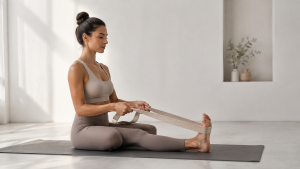
- Lying Hamstring Stretch with Ankle Pumps (1 minute each side): Lie on your back, loop a strap or towel around one foot, and gently pull the leg toward you. Keep the knee soft. As you hold, pump your ankle up and down - that's the shear. Why it works: The hamstring fascia often gets dehydrated overnight. The movement of the ankle creates a wave that travels up the posterior chain, helping the fascia release.
- Chest Opener with Breath (1 minute): Lie over a foam roller or rolled blanket placed lengthwise along your spine. Let your arms open wide. Take deep breaths into the front of your chest. Why it works: Most people sleep with their shoulders rolled forward, shortening the chest fascia. This position uses gravity to lengthen it, and the breath helps the nervous system relax.
A common mistake: people rush through these holds. The thing nobody tells you about fascia work is that it takes at least 30 seconds for the tissue to begin to relax. If you hold for 10 seconds, you're just stretching muscles, not fascia.
Phase 3: Nervous System Wake-Up (2-3 minutes)
Target: full body. This phase signals your nervous system that it's safe to move.
- Standing Full-Body Shake (1 minute): Stand with feet hip-width apart, knees slightly bent. Shake your hands, then your arms, then your legs, then your whole body. Imagine you're trying to shake off a chill. Why it works: This activates the vestibular system and promotes a parasympathetic-to-sympathetic transition. It's also a great way to release residual tension from the night.
- Breath-Based Squat (1 minute): Stand with feet wider than hip-width, toes slightly turned out. Inhale, squat down as low as comfortable, and exhale fully. On the next inhale, stand up. Do 5-10 reps. Why it works: The squat is a primal movement pattern that requires coordination and breath control. It signals to your brain that you're ready to move through the day.
- Spinal Wave (1 minute): From standing, slowly roll down one vertebra at a time, then roll back up. Imagine a wave traveling through your spine. Why it works: This integrates the spine and promotes fluid movement, bridging the gap between the mobility work and daily activity.
If you're someone who feels lightheaded or dizzy when you stand up quickly in the morning, spend extra time in this phase. It's a sign your nervous system is sluggish.
How to Adapt the Routine for Specific Pain Points
Not all stiffness is the same. Here's how to modify the routine based on where you feel the most stuck. I've included edge cases and honest limitations - because sometimes a routine isn't enough.
Lower Back Stiffness
If your lower back feels like it's locked up, skip the cat-cow and go straight to the supine hip circles. Lower back stiffness often originates from the hips. When the hip joints are stiff, you compensate by moving your lumbar spine more, which makes it feel tight. Focus on the hip capsule activation phase and add a knee-to-chest stretch (hold for 30 seconds each side). If you have a history of disc issues, avoid any movement that involves rounding your lower back forcefully - that's a common mistake. Instead, keep your spine neutral and move from the hips.
Shoulder Stiffness
Shoulder stiffness is almost always a combination of chest fascia tightness and poor sleeping position. Add doorway chest stretch (1 minute each side) after the chest opener phase. If you feel a pinch in the front of the shoulder, you're likely going too far back - keep the arm at shoulder height and move slowly. The thread the needle exercise is excellent here, but if you have a rotator cuff injury, avoid the twisting motion and instead do supine shoulder external rotation with a light weight.
Hip Stiffness
Hip stiffness is the most common complaint I hear. The supine hip circles are non-negotiable. If you have a hip replacement or labral tear, do the circles with a smaller range of motion and no weight. For general stiffness, add a figure-four stretch lying on your back (1 minute each side). Many people make the mistake of pulling the leg too aggressively - you want a gentle stretch, not a barbarian pull. The goal is to feel a release, not a sharp sensation.
Progression: How to Scale From 4 to 10 Minutes
When I first started my own morning mobility practice, I tried to do a 10-minute routine and abandoned it after three days. It was too much, too fast. Here's a progression framework that works for real people with real schedules.
- Week 1-2: 4 minutes - Do only Phase 1 (Joint Fluid Activation). That's 2-3 minutes of supine hip circles and thread the needle. Add 1 minute of deep breathing. That's it. The goal is to create a habit, not to fix everything at once.
- Week 3-4: 6 minutes - Add Phase 2 (Fascia Shearing). Pick one exercise from that phase (e.g., child's pose with side bends) and hold it for 2 minutes. Keep Phase 1 at 3 minutes. Total: 5-6 minutes.
- Week 5-6: 8 minutes - Add Phase 3 (Nervous System Wake-Up). Do the full-body shake and breath-based squat. Keep Phase 1 and 2 but reduce each slightly. By now, you'll notice that stiffness is less of a problem.
- Week 7+: 10 minutes - Full routine as described above. You can also swap in variations like a fast full-body warm-up if you're short on time but want a more dynamic option.
Most people underestimate the power of starting small. I've seen clients who couldn't touch their toes in the morning after 4 weeks of just 4 minutes can now do a full squat. The key is consistency, not intensity.
When to Push vs. Ease Off: Differentiating Tightness From Pain
This is the most critical skill in any mobility practice. Tightness feels like a dull, pulling sensation that slowly releases with sustained movement. Pain is sharp, pinching, or radiating. If you feel pain, stop. If you feel tightness, stay with it and breathe.
I once had a client who insisted on "pushing through" a sharp sensation in his hip during a lunge stretch. He ended up with a hip flexor strain that took two weeks to heal. The thing nobody tells you about morning stiffness is that your tissues are more vulnerable right after waking because they haven't been loaded with body weight yet. Pushing into pain can cause micro-tears.
Here's a simple decision matrix: if the sensation decreases as you hold the position (within 30 seconds), it's tightness. If it increases, it's pain. If it's pain, back off and try a different angle or a less intense version. For example, if a deep squat hurts your knees, try a partial squat with a chair behind you.
Another edge case: if you have a diagnosed condition like arthritis or fibromyalgia, your morning stiffness may not respond to mobility alone. In that case, use the routine as a gentle warm-up before doing something like a simple daily walking routine. Walking is often the best mobility tool for chronic stiffness because it's low-impact and rhythmic.
Common Mistakes That Keep You Stiff
I've made every mistake in the book, and I've seen clients repeat them. Here are the ones that matter most.
- Rushing through the warm-up: If you skip the joint fluid phase and go straight to stretching, you're working against dry joint capsules. You'll get more pops and less release.
- Holding your breath: Many people hold their breath during stretches, which keeps the nervous system in a sympathetic state. Exhale on the effort, inhale on the release.
- Using momentum: Jerky, fast movements don't help fascia or joint fluid. They just activate the stretch reflex, which makes muscles tighter. Slow and controlled is the only way.
- Ignoring sleep posture: No amount of morning mobility will fix a night of sleeping in a fetal position on a sagging mattress. If you consistently wake up with the same stiffness, examine your bed setup. Our article on How to Create a Relaxing Bedtime Routine includes tips for aligning your sleep posture that can reduce morning stiffness by half.
What Exercises Are Good for Morning Stiffness? (The Direct Answer)
To answer the question directly: the best exercises for morning stiffness are those that target the specific root cause. For most people, that means a combination of supine hip circles (for joint fluid), child's pose with side bends (for fascia), and full-body shake (for nervous system). But if you have lower back stiffness, prioritize hip circles and knee-to-chest. If you have shoulder stiffness, focus on thread the needle and chest opener. No single exercise works for everyone - that's why the segmented routine is more effective than a generic list.
I've also found that breath-based squatting is a surprisingly effective catch-all. It engages the entire body, requires coordination, and promotes fluid circulation. If you have only 2 minutes, do 10 slow squats with deep breaths, and you'll feel a difference.
Final Thoughts: Make It Yours
The morning mobility routine I've shared here is not a prescription. It's a framework. You can adjust the time, pick the phases that matter most, and swap in exercises that feel good for your body. The goal is not to become hypermobile or to "fix" your body - it's to move with less friction and more ease.
If you're dealing with persistent stiffness that doesn't improve with 4 weeks of consistent practice, consider seeing a physical therapist or a mobility specialist. Sometimes the root cause is structural, not just functional. But for most people, this routine, combined with good sleep hygiene and a consistent practice, will transform your mornings.
Start small. Be patient. And remember: the best routine is the one you actually do.