Why Most Beginner Workouts Fail (and the One Thing That Actually Works)
I remember my first attempt at a 'beginner bodyweight workout.' I found a list of 20 exercises online, tried to do 3 sets of 10, and quit after day two. My shoulders ached, my knees felt weird, and I had no idea if I was doing anything right. Two years later, after coaching dozens of complete beginners, I realized the problem wasn't motivation - it was the plan. Most beginner routines give you too many moves, too many reps, and zero guidance on how to build a habit.
That's why I started using the 3-3-3 rule with my clients. It's dead simple: 3 exercises, 3 sets of 3 reps (or 3 minutes), 3 days a week. For bodyweight beginners, this is the minimum effective dose that actually builds strength and consistency. No gym, no gear, no overwhelm. And it answers the question you probably came here with: What is a good bodyweight exercise routine for a beginner? This is it.
In this guide, I'll walk you through the exact 3-3-3 routine, show you how to fix common form mistakes, and give you a progression ladder so you can keep getting stronger without getting stuck. You'll also learn how to build the habit - because knowing the exercises is only half the battle.
The 3-3-3 Rule Explained (and Why It's Perfect for Beginners)
You might have seen the 3-3-3 rule mentioned in fitness circles, but usually it's about gym workouts or running. For bodyweight exercises, the rule adapts beautifully. Here's how it works:
- 3 exercises - choose one push, one pull, and one leg movement. For beginners, that's a wall push-up, a glute bridge, and a bodyweight squat.
- 3 sets of 3 reps (or 3 minutes of total effort) - start with 3 reps per set. If that feels too easy, you can increase to 3 sets of 30 seconds of work (like a wall push-up hold) or 3 sets of 3 minutes of gentle movement.
- 3 days a week - Monday, Wednesday, Friday (or any non-consecutive days). This gives your muscles 48 hours to recover.
The beauty of this rule is that it's almost impossible to fail. Three reps of a wall push-up takes maybe 10 seconds. You can do it in your pajamas. And because you're not trashing yourself, you're much more likely to show up next time. Most people don't realize that consistency beats intensity for the first 6-8 weeks. The 3-3-3 rule is designed to make you feel like a winner, not a failure.
Now, let's answer the question: What is the 3-3-3 rule for workouts? It's a framework for getting started with minimal friction. It's not a magic formula - it's a psychological hack. When you only have to do 3 reps, your brain doesn't scream 'that's too hard.' And when you finish, you feel good enough to do it again in two days.
Your First 10-Minute Bodyweight Routine (The 3-3-3 Protocol)
Here's the exact routine I use with absolute beginners. It takes about 10 minutes - including a short warm-up. No equipment, no excuses.
Warm-Up (2 minutes)
- 30 seconds of arm circles (small, then big)
- 30 seconds of ankle rolls (each foot)
- 30 seconds of cat-cow stretches (on hands and knees)
- 30 seconds of deep breathing
The 3 Exercises (6 minutes - 3 sets of 3 reps each, with 30 seconds rest between sets)
Exercise 1: Wall Push-Up - Stand an arm's length from a wall. Place your palms flat on the wall at shoulder height. Keep your body straight, bend your elbows, and touch your nose to the wall. Push back up. That's 1 rep. Do 3 reps, rest 30 seconds, repeat for 3 sets.
Exercise 2: Glute Bridge - Lie on your back, knees bent, feet flat on the floor. Squeeze your glutes and lift your hips until your body forms a straight line from shoulders to knees. Lower down. That's 1 rep. Do 3 slow reps, rest 30 seconds, repeat for 3 sets.
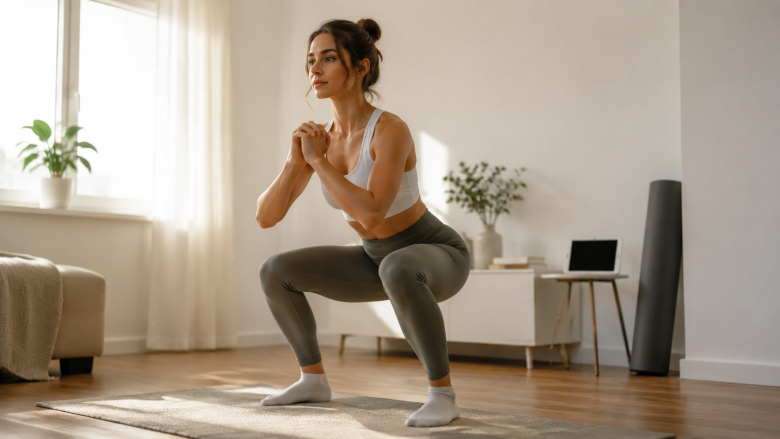
Exercise 3: Bodyweight Squat - Stand with feet shoulder-width apart. Sit back like you're lowering into a chair, keeping your chest up and knees tracking over your toes. Go as low as comfortable, then stand up. That's 1 rep. Do 3 reps, rest 30 seconds, repeat for 3 sets.
That's a full 10-minute workout. If you're thinking, 'That's too easy,' you're right - for now. But remember: the goal is to build the habit first. Once you can do this 3 times a week for 2 weeks, you'll be ready to progress. And that's exactly what we'll cover next.
Also, this routine directly answers What is a good 10-minute bodyweight workout for beginners? - it's this one. Short, simple, and sustainable.
Common Form Mistakes That Beginners Make (and How to Fix Them)
When I started coaching, I assumed beginners would naturally know how to squat or push up. I was wrong. Most people have never been taught proper form. Here are the three most common mistakes I see - and how to fix them.
Mistake 1: Knee Cave in Squats
When you squat, your knees might collapse inward, especially if you're tired. This puts stress on your ACL and MCL. Fix: Place a small object (like a rolled-up towel) between your knees and squeeze it as you squat. This activates your glute medius and keeps your knees aligned. If you can't do a full squat without pain, try a box squat - lower onto a chair, then stand up.
Mistake 2: Sagging Hips in Wall Push-Ups
Your lower back arches and your hips droop toward the floor. This happens because your core isn't engaged. Fix: Before you start, squeeze your glutes and brace your abs as if someone's about to punch you in the stomach. Keep that tension throughout the movement. If you still sag, you're too far from the wall - move your feet closer.
Mistake 3: Holding Your Breath
Almost every beginner holds their breath during reps. This spikes blood pressure and makes you dizzy. Fix: Breathe out on the effort (push up, lift hips, stand up). Breathe in on the release. Count your breaths aloud if needed - it forces you to breathe.
These are the details that most articles skip. They give you a list of exercises and assume you'll figure it out. But the truth is, common form mistakes are the #1 reason beginners quit. They feel pain or weirdness and assume they're not cut out for exercise. In reality, they just need a small adjustment.
Progression Logic: How to Go From Wall Push-Ups to Full Push-Ups
One of the biggest gaps in beginner content is progression logic. Many articles say 'start with wall push-ups, then do incline push-ups, then full push-ups' - but they never explain when or how to switch. Here's a practical ladder.
The Push-Up Progression Ladder
- Level 1: Wall Push-Up - Do 3 sets of 10 reps easily (3x10). When you can do that, move to Level 2.
- Level 2: Incline Push-Up - Use a sturdy table, counter, or bench. Hands on the edge, feet on the floor. Same form. When you can do 3x10, move to Level 3.
- Level 3: Knee Push-Up - On the floor, knees down, hands shoulder-width. Keep your body straight from knees to head. When you can do 3x8, try Level 4.
- Level 4: Full Push-Up - Standard push-up on toes. Start with 3x3 and build up.
Each level should take you 1-2 weeks if you're consistent. The key is to not rush. If you move up too soon, you'll reinforce bad form and risk injury. I've seen people skip from wall push-ups to knee push-ups and end up with shoulder pain because their core wasn't ready.
For the squat, the progression is similar: start with bodyweight squats, then add a hold at the bottom (3 seconds), then try a squat jump (low impact). For glute bridges, you can progress to single-leg bridges or add a weight (like a book or water bottle) on your hips.
This progression logic is exactly what's missing from most beginner guides. They tell you what to do, but not how to get better. And if you're wondering Should beginners start with bodyweight exercises? - absolutely yes, because they allow you to build a foundation of strength and control before adding external load. Barbells and dumbbells can wait.
The Habit-Building Strategy That Actually Works (No Willpower Required)
Knowing the exercises is useless if you don't do them. I've worked with people who have perfect squat form but can't string together three workouts in a row. That's why the habit-building part is crucial. Here's a system based on what I've seen work.
The 'Never Miss Twice' Rule
Miss a day? Fine. Don't miss two in a row. If you skip Monday, you must do the workout on Tuesday, even if it's just the 3 reps. This prevents the 'I'll start again next week' spiral.
The 2-Minute Rule
Tell yourself you only have to do the warm-up. If you still feel like stopping after 2 minutes, you can stop. In practice, 99% of the time you'll keep going. The hardest part is starting.
Anchor Your Workout to an Existing Habit
Do your 3-3-3 routine right after brushing your teeth in the morning or right before your first coffee. This is called habit stacking. It's far more reliable than 'I'll do it when I have time.'
I also recommend tracking your workouts with a simple checkbox on a calendar. Seeing a chain of X's is motivating. For calorie tracking, you can use our Strength Calories For Beginners Calculator to estimate how many calories you're burning during bodyweight exercises - it's a nice bonus, but don't obsess over it. The real goal is consistency.
And if you're curious about how many calories you burn during a 10-minute walk (which pairs beautifully with this routine), check out the Walk Calories For Beginners Calculator. Walking is a perfect active recovery on your off days.
When to Increase the Volume (and When to Hold Back)
One of the trickiest things for beginners is knowing when to progress. You don't want to stay at 3 reps forever, but you also don't want to jump to 3x10 too fast. Here's a simple rule of thumb: if you can complete all 3 sets of 3 reps with perfect form and no pain for two weeks, you can increase one variable.
You have three levers: reps, sets, and difficulty. Only change one at a time. For example:
- Week 1-2: 3 sets of 3 reps (wall push-up, glute bridge, squat)
- Week 3-4: 3 sets of 5 reps (same exercises)
- Week 5-6: 3 sets of 5 reps, but increase difficulty (e.g., incline push-up instead of wall)
This slow, methodical approach prevents injury and builds confidence. The thing nobody tells you about bodyweight training is that progress is not linear. Some weeks you'll feel stronger, some weeks you'll feel like you're back at square one. That's normal. Your body needs rest, sleep, and food. If you're tired, stick to the 3-3-3 rule and don't push harder.
On days when you're sore from a previous workout, you can do an active recovery session. Our guide on How to Build Easy Morning Stretch Habits is a great complement to this routine. A few minutes of stretching can reduce soreness and improve your range of motion for the next workout.
What About When You Travel or Get Sick?
Life happens. You might go on vacation or catch a cold. The 3-3-3 rule is flexible enough to adapt. If you're in a hotel room, you can do wall push-ups against the bathroom door or glute bridges on the bed. If you're sick, skip the workout entirely - your body needs energy to heal. Don't feel guilty. The 'never miss twice' rule still applies: once you're better, do your next workout.
I've also had clients ask if they can do the 3-3-3 routine on a plane or in a small space. Absolutely. You can do seated glute squeezes, isometric wall push-ups (hold the push position for 3 seconds), and standing squats. The 3-3-3 rule is about using your own bodyweight, and you always have that with you.
Frequently Asked Questions (Answered Naturally)
You might still have some doubts. Let me address a few that come up all the time.
Should beginners start with bodyweight exercises? Yes, for several reasons. Bodyweight exercises teach you how to control your own body before you add external weight. They reduce the risk of injury because you're lifting something you're familiar with (yourself). They also build joint stability and proprioception (awareness of your body in space). Once you can do 3 sets of 10 full push-ups, then you can consider adding resistance bands or dumbbells. But for the first 2-3 months, bodyweight is ideal.
What is the 3-3-3 rule for workouts? I explained it earlier, but to reiterate: 3 exercises, 3 sets of 3 reps (or 3 minutes), 3 days a week. It's a minimalist framework that prioritizes habit formation over intensity. It's not a long-term solution - eventually you'll need to progress - but it's the best way to get started.
What is a good 10-minute bodyweight workout for beginners? The one I outlined above: wall push-ups, glute bridges, and bodyweight squats, 3 sets of 3 reps each, with a 2-minute warm-up. That's 10 minutes total. If you want to extend it, you can add a fourth exercise like a plank hold (3 sets of 15 seconds) or a bird-dog (3 sets of 3 reps per side).
I've intentionally avoided a separate FAQ section because these answers flow naturally from the content. But if you're still wondering about something specific, read on - the next section covers more real-world scenarios.
Real People, Real Results: A Case Study
Let me share a story that illustrates the power of the 3-3-3 rule. A client of mine, Sarah, was a 45-year-old office worker who had never exercised consistently. She tried a 30-minute YouTube workout and felt so sore she couldn't walk for three days. She quit for a year. When she came to me, I started her on the 3-3-3 rule. At first, she laughed at how easy it was. 'I can do 3 wall push-ups in my sleep,' she said. I told her to trust the process.
She did the 3-3-3 routine for 3 weeks. Then she moved to 3 sets of 5 reps. Then 3 sets of 8. Then she switched to incline push-ups. After 8 weeks, she could do 3 sets of 10 full push-ups - something she never thought possible. More importantly, she had built the habit. She did her workouts without thinking. She told me, 'It's like brushing my teeth now.'
That's the goal. Not to be a fitness influencer, but to have a sustainable practice that keeps you healthy. The 3-3-3 rule is a gateway. Once you master it, you can explore other types of movement - like walking, swimming, or even weightlifting. If you're curious about calorie expenditure during low-impact activities, the Crawl Calories For Beginners Calculator gives you an idea for crawling (yes, it's a real exercise). And for hydration, since you'll be sweating more, the Watering Calories For Beginners Calculator can help you estimate water needs during exercise.
Final Thoughts: The Minimum Effective Dose Works
If you take nothing else from this article, remember this: you don't need a complicated workout to get started. The 3-3-3 rule is designed to remove every barrier. No equipment, no gym, no long sessions. Just 10 minutes, 3 days a week, with 3 simple movements. Focus on your form, fix your mistakes, and progress slowly. The habit is more important than the workout.
Most articles on 'easy bodyweight exercises for beginners' list 20 moves and expect you to figure out a routine. That's overwhelming. This approach is different. It's the one I use with real clients, and it works because it respects your time and your current fitness level. Start today. Do three wall push-ups, three glute bridges, and three squats. That's it. You've done your first workout. Now do it again in two days. And then again. Before you know it, you'll be stronger, more confident, and ready for the next challenge.